
AI Stack
Key takeaway
An AI stack is a layered architecture for designing, operating, and governing AI systems end to end. It has five layers from top to bottom: application, orchestration, data, model, and infrastructure. Each upper layer depends on the one below it, so teams build from stable infrastructure upward to reliable, user-facing AI applications.
An AI stack is a layered architecture that helps teams design, operate, and govern AI systems end to end. Start at the bottom with reliable infrastructure, then move upward through models, data, and orchestration to business-facing applications.
AI Stack Layers (Top to Bottom)
- Application
- Orchestration
- Data
- Model
- Infrastructure
This top-to-bottom view reflects what users see at the top while reminding teams that each upper layer depends on the layer below it.
Visual Layer Diagram
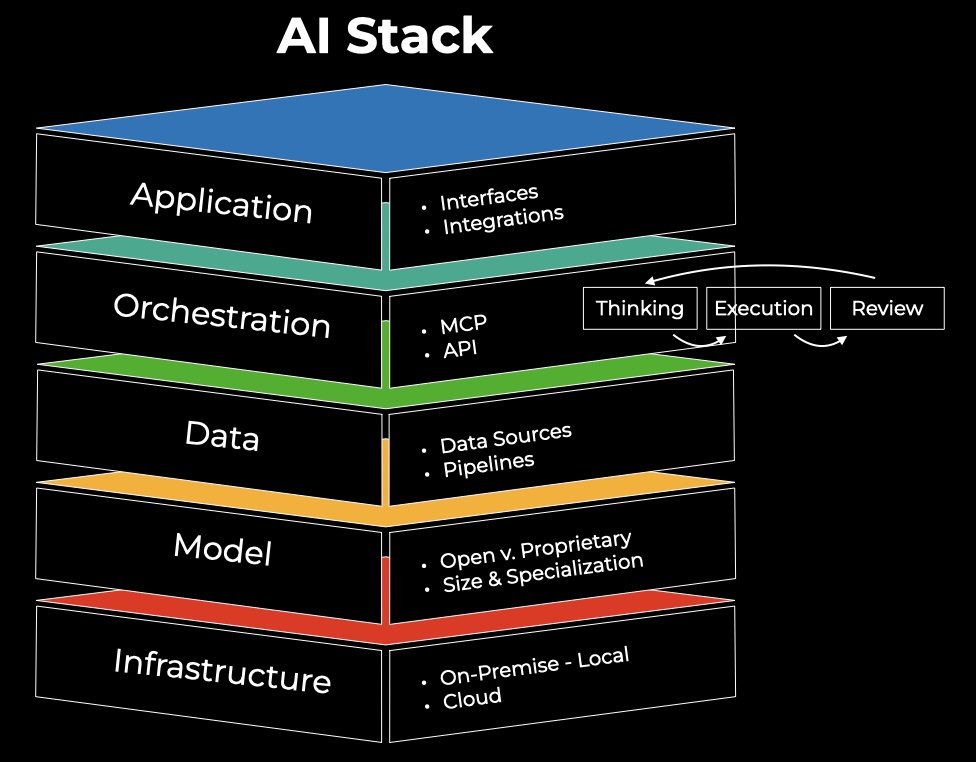
AI Stack at a glance Application -> Orchestration -> Data -> Model -> Infrastructure
Key point Start with stable infrastructure and governance, then build upward to reliable user-facing applications.
1) Application
This is where business value is delivered: copilots, search, recommendation, automation, and decision support experiences.
- Define clear user outcomes and success metrics.
- Design for trust, explainability, and safe user interactions.
- Integrate with existing business workflows and systems of record.
2) Orchestration
Orchestration coordinates prompts, tools, policies, routing, and multi-step workflows across services.
- Manage prompt templates, routing logic, and agent/tool calls.
- Enforce guardrails, approvals, and policy checks.
- Capture observability signals (latency, failures, cost, quality).
3) Data
Data provides context, grounding, and quality signals for training and inference.
- Build governed pipelines for ingestion, transformation, and serving.
- Maintain quality controls, lineage, ownership, and access controls.
- Support retrieval patterns (for example, vector search and metadata filtering).
4) Model
The model layer includes foundation models, fine-tuned models, and evaluation practices.
- Select models by capability, risk, latency, and total cost.
- Evaluate continuously for quality, bias, drift, and robustness.
- Version and govern models with clear release and rollback controls.
5) Infrastructure
Infrastructure is the base layer that powers every other layer: compute, storage, networking, security, and platform operations.
- Provide scalable compute for training and inference.
- Implement reliability, security, secrets management, and disaster recovery.
- Track unit economics with cost controls and capacity planning.
Implementation Guidance
- Build from the bottom up for reliability, then optimize from the top down for user value.
- Assign ownership per layer to avoid cross-team ambiguity.
- Define measurable SLAs across latency, quality, security, and cost.
Next Steps
Ready to move from strategy to measurable impact?
Sources
Frequently asked questions
What are the layers of an AI stack?
An AI stack has five layers. The application layer delivers business value through copilots, search, and automation. Orchestration coordinates prompts, tools, and workflows. The data layer provides context and grounding. The model layer covers foundation and fine-tuned models. Infrastructure supplies compute, storage, networking, and security.
What does the orchestration layer do in an AI stack?
The orchestration layer coordinates prompts, tools, policies, routing, and multi-step workflows across services. It manages prompt templates and agent or tool calls, enforces guardrails, approvals, and policy checks, and captures observability signals such as latency, failures, cost, and quality so teams can see how AI workflows behave.
How should we choose an AI model?
Choose an AI model based on capability, risk, latency, and total cost rather than capability alone. After selection, evaluate the model continuously for quality, bias, drift, and robustness, and version and govern it with clear release and rollback controls so it can be replaced safely when needs change.
Where should we start when building an AI stack?
Start building an AI stack at the bottom with stable infrastructure and governance, then work upward to user-facing applications. Build bottom up for reliability, then optimize top down for user value. Assign ownership per layer and define measurable SLAs for latency, quality, security, and cost.